
Blessing Held for Long-Awaited Lānaʻi Housing Project
“We've been fighting for affordable housing for Lānaʻi for over 30 years,” Councilmember Gabe Johnson said. “And we finally are going to do a blessing, and it's finally here, folks.”
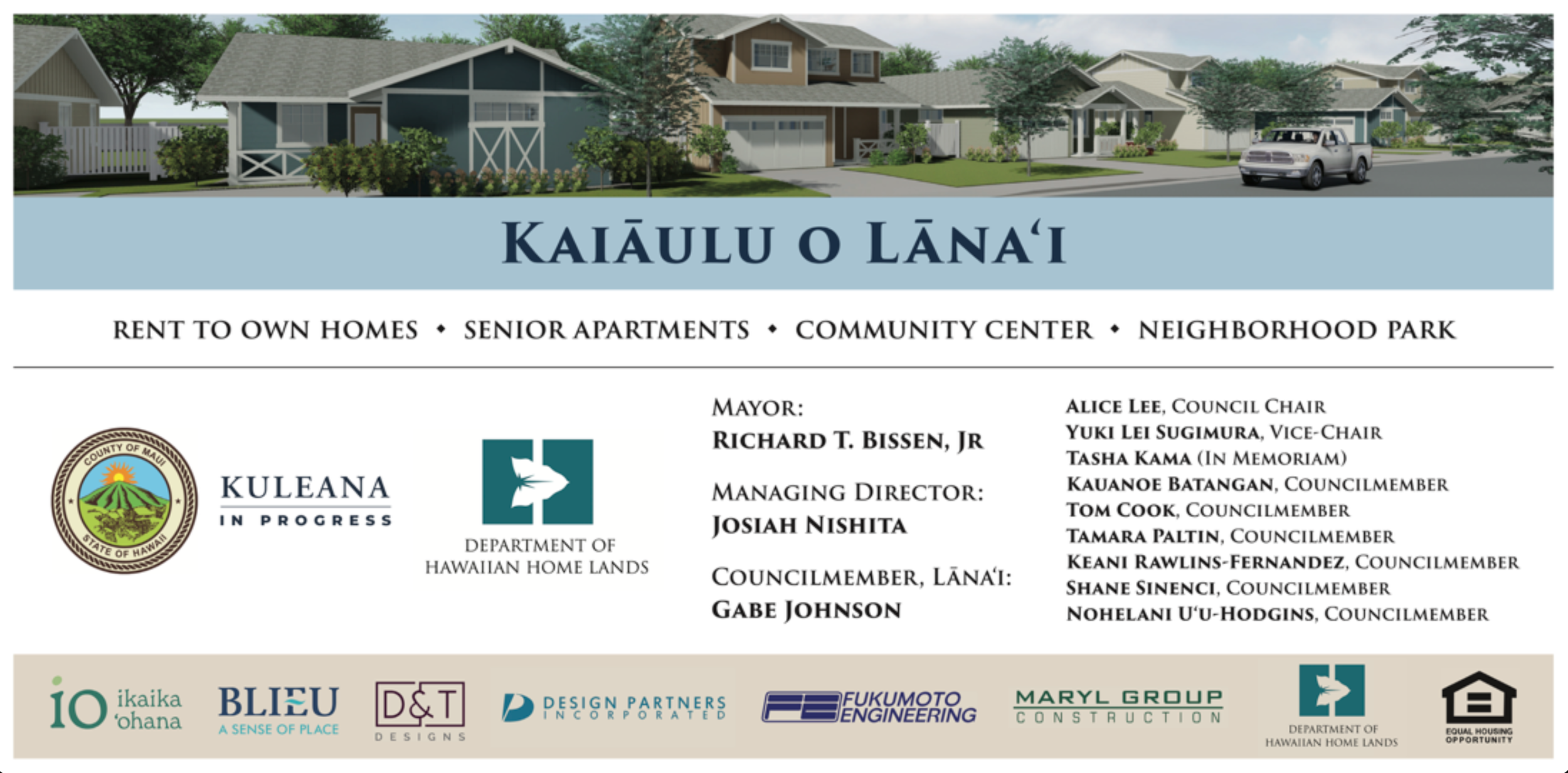
The February 18 blessing for the Lānaʻi affordable housing project, Kaiāulu o Lānaʻi, was held at the bottom of Fifth Street, at the entrance to Hawaiian Homes, fronting the County parcel designated for the project. The ceremony marked the start of Phase 1 construction where 72 affordable units are planned.
For decades, Lānaʻi has faced a limited housing inventory, few rental options, and rising costs that outpace many local incomes. Families have reported overcrowded living arrangements, adult children remaining in childhood homes longer than planned, and workers turning down jobs due to lack of available housing. County and state discussions over the years have repeatedly identified housing supply as one of the island’s most persistent structural challenges.
The gathering included Mayor Richard T. Bissen, Jr.; County Director of Housing Richard Mitchell; Chairman of the Department of Hawaiian Home Lands Kali Watson; Douglas Bigley and Tom Fischer of Ikaika ʻOhana; and Mark Kong of Maryl Group Construction, Inc.
“Before I was a councilmember, I was a single father living in low-income housing, Section 8,” CM Johnson said. “Struggling with bills made my life experience really hit the pavement here and say, this is what this community needs.” He continued, “I know the struggle, and the struggle is real for our community, and to have something that you could eventually own. I can't tell you how important it is.”
The development model moving forward reflects feedback collected during earlier outreach across Lānaʻi City. “We interviewed 400 households, and we asked them, ‘What do you want? How many bedrooms? You want rent-to-own? You want to buyout?’” CM Johnson said. The responses influenced the decision to implement a rent-to-own pathway and shaped the emphasis on three- and four-bedroom homes intended for local families.
Phase 1 calls for 46 single-family homes and 26 multi-family kūpuna units, totaling 72 affordable units. Of the single-family homes, 38 are planned as three-bedroom units and eight as four-bedroom units, each on a minimum 6,000 square foot lot. The kūpuna building will include 24 one-bedroom units and two three-bedroom manager units, with 33 parking stalls designated for senior housing.
Mayor Richard T. Bissen, Jr. addressed the administration’s role in advancing the project through budgeting and coordination. “We know by creating more affordable housing, we are also helping to preserve this island, this island's unique character, and of course, the sense of community while we're also helping to stabilize your local workforce,” he said. The project secured $17.2 million in the FY ’26 County budget to move forward with infrastructure and vertical construction.
Rental rates for the project will follow HUD Area Median Income guidelines for Lānaʻi City, targeting households earning between 30 percent and 80 percent of AMI. The single-family homes will operate under a rent-to-own structure allowing tenants to rent for up to 15 years before purchasing at a fixed affordable price. County officials have described the model as a pathway for families who need time to build credit, savings, or stability before transitioning to ownership.
During remarks, Douglas Bigley of Ikaika ʻOhana referenced prior conversations about keeping the timeline tight. “[CM Johnson] says, ‘You got to condense the schedule. It’s urgent,’” Bigley said.
Ikaika ʻOhana, the nonprofit developer overseeing the project, has built and managed multiple affordable housing developments across Maui County, including rental and rent-to-own communities on Maui and Hawaiʻi Island. The organization works in partnership with counties and state agencies to layer financing, manage long-term compliance, and oversee on-site property management after construction. Their role on Lānaʻi includes development oversight, coordination of infrastructure planning, and long-term management of the rental and rent-to-own components once residents move in.
CM Johnson recalled walking the parcel years earlier when it was still an open field under consideration. “He shook my hand in that field and said, ‘we can build on this,’” CM Johnson said. “And then, here we are.”
The program concluded with protocol. “Okay, next, we're going to bring up Saul for the blessing,” CM Johnson said. Saul Kahihikolo led the blessing, marking the formal start of Kaiāulu o Lānaʻi at the bottom of Fifth Street.